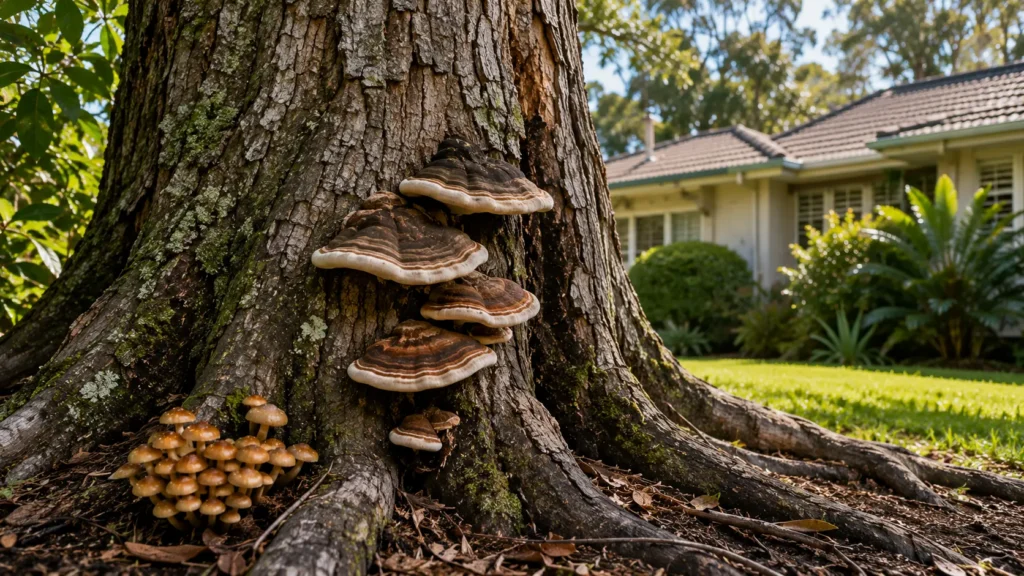
Spotting a cluster of mushrooms or a shelf of bracket fungi growing on your backyard tree can be alarming, and for good reason. While not every instance of fungal growth signals immediate danger, tree fungus is never something to dismiss without closer inspection. For homeowners across Sydney’s North Shore and Northern Beaches, understanding what tree fungus actually means for your tree’s health could help you avoid a costly, or dangerous, situation down the line.
At Pro Climbing Tree Services, we regularly assess trees affected by fungal disease across suburbs including Manly, Seaforth, Lindfield, Pymble, Dee Why, and Wahroonga. In our experience, the key is knowing what type of fungus you’re dealing with, where it’s growing, and what it tells you about the condition of the wood beneath.
What Is Tree Fungus, Really?
Tree fungus is a broad term that covers a range of fungal organisms that colonise and feed on wood. Most species of fungi that affect trees are decomposers, they break down organic material, including the cellulose and lignin that give wood its strength and structure. In nature, this is an essential ecological process. In your backyard, however, it means that the structural integrity of your tree is being actively broken down.
The visible parts of tree fungus, mushrooms, brackets, conks, or powdery coatings on leaves, are actually just the reproductive stage of the organism. The real damage is done by the mycelium, an invisible network of fungal threads that penetrates deep into the wood and breaks it down from within. By the time you see fruiting bodies on the outside of a tree, the fungal infection has typically been present internally for months, sometimes years.
Common Types of Tree Fungus Found in Sydney
Bracket Fungi (Shelf Fungi)
Bracket fungi, also called shelf fungi or conks, are among the most serious indicators of internal wood decay. These hard, shelf-like growths protrude from the trunk or major branches and are a sign of heart rot, a condition where the internal heartwood is being broken down. Species such as Ganoderma are commonly found on a range of tree species across Sydney, including eucalypts, figs, and exotic ornamentals.
Heart rot weakens the structural core of a tree without necessarily affecting the living outer layers. This means a tree with extensive bracket fungi may still appear green and healthy while being dangerously hollow inside.
Armillaria (Honey Fungus)
Armillaria, commonly known as honey fungus, is one of the most destructive fungal pathogens affecting trees in the Sydney region. It attacks the root system and the base of the trunk, causing what arborists call white rot. Infected trees show clusters of honey-coloured mushrooms at the base, along with a characteristic white, fan-shaped mycelial layer beneath the bark at the soil line.
Armillaria spreads underground via rhizomorphs, root-like fungal strands, which means it can move from one tree to an adjacent one on your property. In tightly planted gardens or where trees share a root zone, a single infected tree can threaten its neighbours.
Powdery Mildew and Sooty Mould
Not all tree fungi cause structural damage. Powdery mildew and sooty mould affect a tree’s leaves and surface rather than its wood. While these can weaken a tree through reduced photosynthesis and aesthetic decline, they are generally manageable with appropriate treatment and are far less structurally threatening than wood-rot fungi.
Phytophthora Root Rot
Phytophthora is a water mould (technically not a true fungus, but commonly grouped with fungal pathogens) that thrives in waterlogged or poorly drained soils. It attacks root systems, causing them to rot and reducing the tree’s ability to absorb water and nutrients. Trees affected by Phytophthora often show yellowing leaves, stunted growth, and branch dieback, symptoms that can be mistaken for drought stress or nutrient deficiency.
In Sydney’s heavier clay soils, particularly in lower-lying areas of suburbs like St Ives, Forestville, and Cheltenham, Phytophthora is a recurring issue following periods of heavy rain.
When Is Tree Fungus Dangerous?
This is the critical question, and the honest answer is: it depends on several factors. Not all fungal infections make a tree imminently dangerous, but they all warrant evaluation. The risk level is determined by:
Location of the Fungal Growth
Fungal growth at the base of the trunk or on major structural roots is far more concerning than growth on small, outer branches. Basal and root decay undermines the tree’s anchorage, its ability to remain upright in wind. A tree with significant basal decay near a home, fence, vehicle, or area where people regularly gather represents a high-risk situation.
Extent of Internal Decay
The size and number of fruiting bodies visible on a tree give some indication of how long the fungal infection has been present and how far the internal decay may have progressed. A single small bracket on a minor branch is very different from multiple large conks on the main trunk. Where significant decay is suspected, an experienced arborist can use a mallet test, resistograph drilling, or sonic tomography to assess the extent of internal hollowing.
Species of Tree
Some tree species are more tolerant of internal decay than others. Certain eucalyptus species, for example, are naturally adapted to some degree of hollowing and can remain structurally stable even with significant internal decay. Other species, including many exotic ornamentals commonly found in North Shore gardens, have less tolerance for structural compromise and fail more quickly once decay is established.
Tree Size and Proximity to Targets
A small ornamental tree with heart rot in a paddock is a very different proposition to a large spotted gum with the same condition overhanging a home in Turramurra or a busy driveway in Narrabeen. Risk assessment in arboriculture always considers both the likelihood of failure and the consequence of failure, what would be damaged if the tree or a part of it came down.
What Should You Do If You Find Fungus on Your Tree?
The most important first step is not to panic, but equally, don’t ignore it. Here’s what we recommend:
Don’t remove the fungus yourself. Removing the visible fruiting bodies does not address the underlying infection and can make it harder for an arborist to assess the situation accurately. Leave it in place until a professional has had a chance to inspect the tree.
Arrange an arborist inspection. A qualified arborist can assess the type of fungal infection, estimate the degree of internal decay, and advise on the appropriate course of action, whether that’s monitoring, targeted pruning to reduce load and wind resistance, or full tree removal where the risk is unacceptable.
Consider the surrounding trees. If a fungal pathogen like Armillaria is present, adjacent trees may also be at risk. Ask your arborist to cast an eye over neighbouring trees at the same time.
Act sooner rather than later. Trees with fungal decay don’t follow a predictable failure timeline. They can remain standing for years or fail suddenly during a wind event. Given Sydney’s storm season, a tree showing signs of fungal decay near a structure should be assessed before summer storms arrive.
Can a Tree with Fungus Be Saved?
In some cases, yes. If the infection is caught early, is confined to a limited area, and the tree’s structural wood remains largely intact, targeted pruning and improved growing conditions (better drainage, reduced soil compaction, appropriate fertilisation) can slow or limit the progression of the disease. However, wood that has already been broken down by fungal decay cannot be restored, the goal of treatment is to prevent further deterioration, not to reverse existing damage.
Where heart rot or root decay has compromised a tree’s structural integrity beyond a safe threshold, removal is the responsible course of action. Our arborists will always discuss your options honestly, including whether the tree is a candidate for monitoring versus removal.
Protect Your Property with a Professional Tree Health Assessment
Tree fungus is one of those issues where professional eyes make all the difference. What looks like a minor cosmetic issue to a homeowner can signal advanced structural decline to an experienced arborist. Conversely, what seems alarming to the untrained eye may turn out to be a manageable surface condition.
Pro Climbing Tree Services serves the full length of Sydney’s Northern Beaches and North Shore, from Manly and Brookvale in the south through to Palm Beach in the north, and from Lane Cove and Chatswood across to Hornsby and the Hills District. Our arborists bring genuine expertise and local knowledge to every assessment, giving you clear, practical advice you can act on.
If a tree has been involved in a sudden failure event, our emergency tree services are also available around the clock to make your property safe quickly.
Contact Pro Climbing Tree Services Today
Don’t wait until a fungal-affected tree becomes an emergency. Whether you’ve noticed mushrooms at the base of a tree, bracket fungi on the trunk, or your tree just doesn’t look quite right, our team is here to help with honest, expert assessment and professional care.
Contact Pro Climbing Tree Services today for a free quote, call us or fill out our online form.