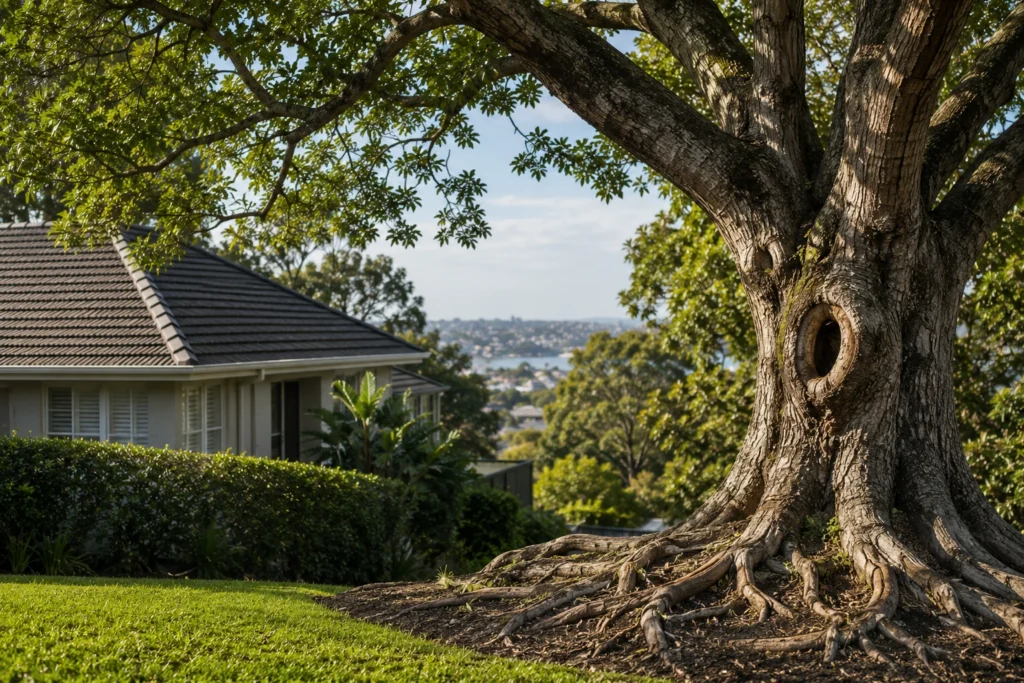
It’s one of the most unsettling questions a homeowner can face: could the large tree in my backyard come down without any warning? The short answer is yes, and it happens more often than most people expect. Across Sydney’s Northern Beaches and North Shore, trees that appeared perfectly healthy have failed suddenly, causing serious damage to homes, cars, fences, and in the worst cases, injuring people.
The troubling reality is that many of the factors that make a tree dangerous are hidden, invisible to the untrained eye until it’s too late. In this article, the arborists at Pro Climbing Tree Services explain the hidden risk factors behind sudden tree failure, and what you can do to protect your property and loved ones.
Why Trees Fall “Without Warning”
When a tree falls and there’s no obvious preceding damage, people are often shocked. But the truth is that warning signs almost always exist, they’re just not always visible from the ground, or they’re easy to dismiss if you don’t know what to look for.
Internal decay is the most common hidden culprit. A tree can have a completely hollowed-out trunk while still producing healthy-looking foliage, because the outer layers of wood and bark can remain intact even as the structural core rots away. From the street, the tree looks fine. Inside, it may have very little load-bearing capacity left.
Understanding the difference between a tree that looks healthy and a tree that is structurally sound is something that requires professional training and, in many cases, specialist equipment. That’s why regular arborist inspections are so important, especially for large trees in residential areas like Manly, Dee Why, Mona Vale, and Frenchs Forest on Sydney’s Northern Beaches, or Wahroonga, Gordon, and Lindfield on the North Shore.
Hidden Risk Factor 1: Internal Decay and Hollow Trunks
As described above, internal decay is perhaps the most dangerous hidden risk factor because it progresses silently. Caused by fungal pathogens that enter through wounds, old pruning cuts, storm damage, or pest entry points, internal decay can hollow out significant portions of a trunk or major limbs while leaving the bark and outer wood intact.
Arborists use a range of methods to detect internal decay, including sound testing (tapping the trunk and listening for hollow resonance), resistance drilling (which measures changes in wood density as the drill penetrates the trunk), and in some cases, sonic tomography, a technology that creates a cross-sectional image of the wood’s internal condition.
External signs that may indicate internal decay include bracket fungi growing from the trunk, cracks or cavities in the bark, soft or discoloured sections at the base of the tree, and an unusually hollow sound when the trunk is struck. However, the absence of these signs does not guarantee a sound tree, which is why proactive assessment matters.
Hidden Risk Factor 2: Root Plate Failure
A tree’s root system is its anchor, without a sound and extensive root plate, even a tree with a perfectly healthy trunk can topple in high winds. Root plate failure occurs when the roots are unable to hold the tree in the soil, often as a result of root damage, soil disturbance, or prolonged waterlogging.
On Sydney’s Northern Beaches, where sandy coastal soils offer less stability than clay-based soils, root plate failure is a recognised risk, particularly for large trees like Paperbarks, Angophoras, and introduced species like Coral Trees and Morton Bay Figs. In North Shore suburbs like Turramurra and St Ives, where properties frequently border creek lines and bushland, soil saturation after heavy rain can dramatically reduce root anchorage.
Warning signs of root plate issues include soil heaving or cracking around the base of the tree (particularly on the side opposite the lean), recent changes in tree lean, and areas of exposed or damaged surface roots. Construction work, trenching, or significant soil disturbance near the root zone can also indicate elevated risk, even if the disturbance occurred several years ago.
Hidden Risk Factor 3: Structural Defects in the Crown
Not all tree failures originate in the trunk or roots. A significant proportion of tree-related property damage in Sydney results from branch failure, sometimes from limbs that appeared solid and healthy. Structural defects in the crown, such as co-dominant stems with included bark, tight V-shaped branch unions, and over-extended limbs with excessive end weight, can all lead to sudden failure.
Included bark is a particularly deceptive defect. It occurs when two stems or a branch and the main trunk grow so closely together that bark becomes embedded between them, preventing a strong wood-to-wood bond from forming. From a distance, an included bark union can look perfectly fine. Under stress, such as during a wind event, or simply due to the increasing weight of a growing crown, it can split catastrophically.
This type of defect is common in species like Brushbox, Camphor Laurel, and many ornamental species frequently planted in North Shore and Northern Beaches gardens. Regular professional tree pruning in Sydney that targets these structural defects early is one of the most effective preventative measures available to property owners.
Hidden Risk Factor 4: Compromised Root Zones
Modern urban development frequently places trees under significant stress through changes to their root zones. Raising or lowering soil levels around the base of a tree, paving over root zones, compaction from vehicle traffic or construction, and the introduction of fill material can all suffocate roots, alter drainage, and fundamentally change a tree’s relationship with the soil it depends on.
In rapidly developing areas of Sydney’s North Shore, including Ryde, Meadowbank, and West Pennant Hills, urban infill and renovation projects regularly disturb the root zones of large established trees. The effects may not manifest immediately; a tree can survive for several years in a compromised state before its condition deteriorates to the point of structural failure.
Property owners planning any construction, landscaping, or civil works within the vicinity of large trees should always consult an arborist beforehand. Establishing a Tree Protection Zone and managing activities within it can make the difference between a tree that survives development and one that becomes a hazard within a few years.
Hidden Risk Factor 5: Pest and Disease Weakening
Chronic pest infestation and disease can gradually weaken a tree’s structural integrity over time, even when visible symptoms are subtle. Sap-sucking insects reduce a tree’s energy reserves; timber borers tunnel through wood and create pathways for fungal entry; soil pathogens such as Phytophthora cinnamomi (cinnamon fungus) can devastate root systems, particularly in native trees across bushland-adjacent properties in the Northern Beaches.
A tree weakened by ongoing pest or disease pressure may cope adequately under normal conditions but fail under additional stress, such as a dry summer followed by a sudden heavy downpour, or a period of strong westerly winds. The danger is that the underlying weakening is not visible from outside; by the time obvious symptoms appear in the canopy, the structural damage may already be significant.
Hidden Risk Factor 6: Recent Soil Saturation or Drought
Weather events themselves can be hidden risk factors, independent of any underlying tree condition. Extended drought followed by heavy rainfall, a pattern increasingly common across the Sydney Basin, can create instability even in otherwise healthy trees. Drought stress weakens roots and can cause fine root dieback; when soils then become saturated, the combination of weakened roots and wet, heavy soil provides very little anchorage.
After significant rain events, the risk of tree failure is elevated for days and even weeks as soils remain saturated. This is why emergency tree services in Sydney are in such high demand during and after storm season, not just because of direct storm damage, but because of the cascading effects on root stability and overall tree structure.
What You Can Do Right Now
The most important action any property owner can take is to arrange a professional arborist inspection for any large trees on their property, particularly those near structures, parked vehicles, or areas where people spend time. A qualified arborist will assess visible and accessible indicators of tree health and structural integrity, and can recommend appropriate action ranging from nothing (the tree is fine) to targeted pruning, cabling and bracing, or removal.
Some practical steps you can take today include:
- Walk around your trees and look for visible cracks, cavities, or fungi at the base or on the trunk
- Note any recent changes in lean or any heaving of soil around the base
- Check for dead branches or areas of canopy dieback
- Be aware of any construction or soil disturbance that has occurred near the tree in recent years
- Book an annual arborist inspection, especially before storm season
If anything looks concerning, don’t wait. The cost of an arborist assessment is minimal compared to the potential cost, financial and personal, of a tree failure.
When to Call for Emergency Help
If you notice a tree leaning suddenly, hear cracking sounds from within the trunk, or see soil heaving around the base, particularly during or after a storm, this constitutes an emergency. Do not approach the tree. Keep family members and pets clear of the area and contact a qualified arborist with emergency response capability immediately.
Pro Climbing Tree Services provides emergency tree services across Sydney’s Northern Beaches and North Shore, with rapid response for situations that can’t wait. Our team is equipped to safely stabilise, remove, or manage hazardous trees in residential and commercial settings.
Don’t Leave It to Chance
Trees are an invaluable part of Sydney’s landscape, and most trees, with proper care, pose no significant risk. But large trees in urban settings deserve the same level of ongoing attention as other major structural elements of your property. Hidden risk factors are real, they’re common, and they can cause serious harm when overlooked.
The good news? Most tree failures are preventable with the right knowledge, regular inspection, and timely professional intervention. Don’t wait for the worst to happen, be proactive about your trees’ health and structural integrity.
Contact Pro Climbing Tree Services Today
Pro Climbing Tree Services is a team of fully qualified, fully insured arborists serving Sydney’s North Shore, Northern Beaches, and surrounding suburbs. We offer professional tree risk assessments, tree removal, pruning and crown management, stump grinding, land clearing, and emergency tree services.